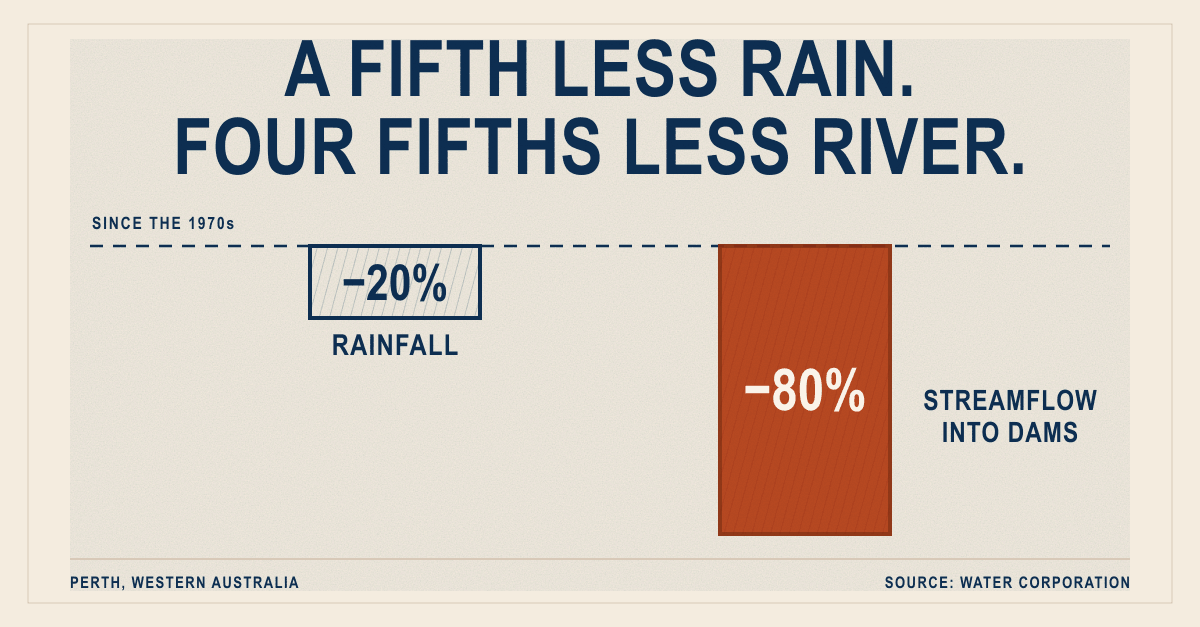
Perth’s rainfall has fallen about 20 percent since the 1970s.
Its river flows have fallen 80 percent.
Same page, same utility’s website. A fifth less rain did not produce a fifth less water. It produced four fifths less. Before 1975, Perth’s dams took in an average of 420 billion litres a year. Between 2010 and 2018 the average was 72.5 billion. In 2015 they received 15.8 billion, the lowest since records began in 1911, which the utility helpfully translates as about fourteen hot summer days of supply.
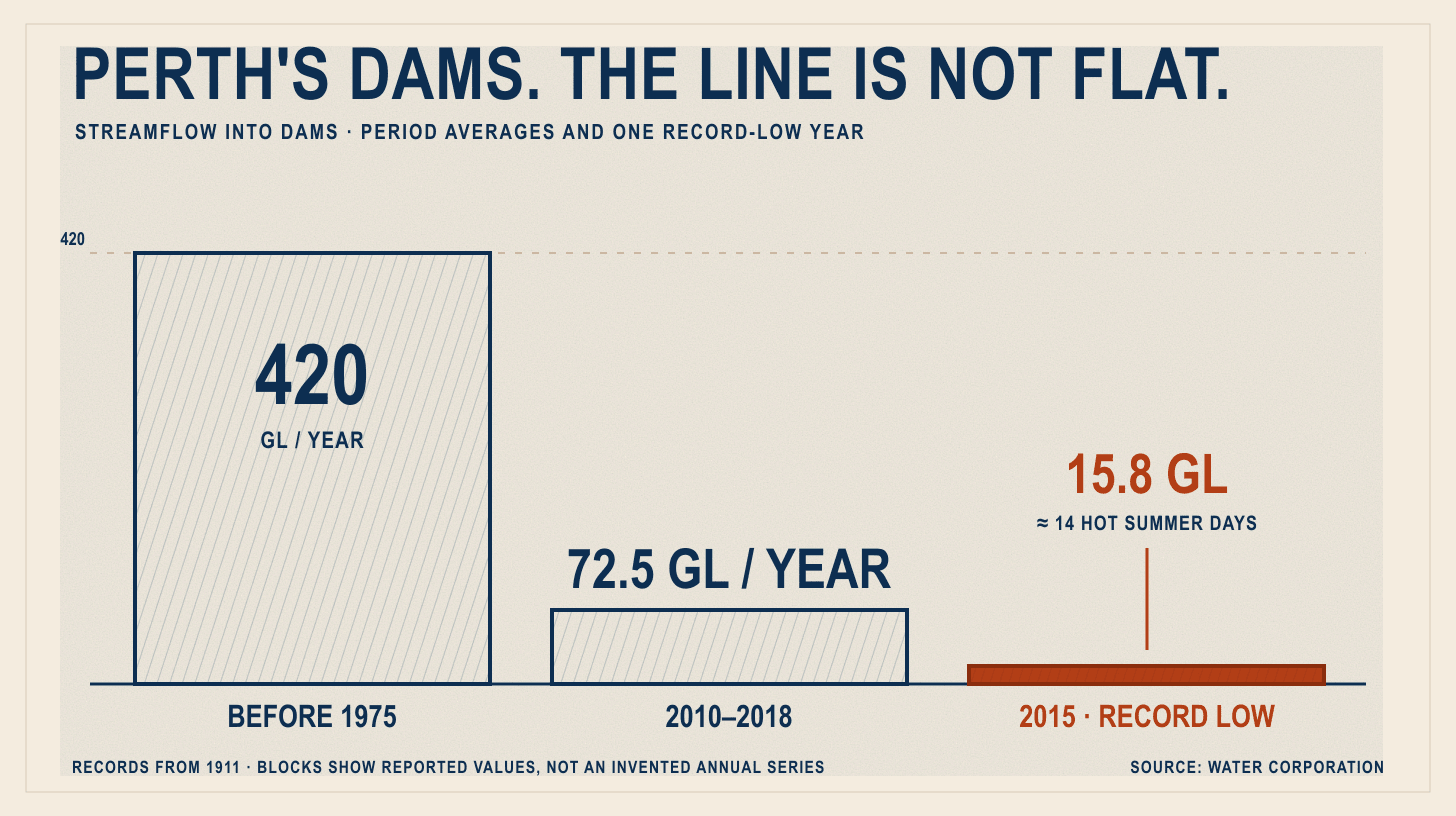
If your business case converts rainfall into water availability on a straight line, that line has a problem.
The utility nobody built
Rain does not go from cloud to tap. It soaks in and spends months, years or millennia underground, and while it is down there the ground does three jobs.
It stores. An aquifer is a reservoir that never needed planning permission, holds more than any tank you could finance, and carries a city through a dry year without anyone having decided to build it. It is a buffer against being wrong about the weather.
It treats. Filtration through sediment, sorption onto mineral surfaces, biological degradation over long residence times. Slow, thorough and free. The technical term is natural attenuation, and it is the reason spring water was drinkable long before anyone understood why.
It moves. Water arrives at the abstraction point having transported itself, on gravity, with no pump station and no electricity contract.
This arrangement is older than agriculture, older than cities, and vastly older than the concept of a utility. It has been running since rain first fell on rock. No invoice, no price increase, no stakeholder consultation. Every water system humans have built sits on top of it and treats it the way we treat atmospheric pressure: a condition of the world, not a service with a cost.
It was never as large as it appears, either. Gleeson and colleagues, writing in Nature Geoscience, estimated that of roughly 22.6 million cubic kilometres of groundwater held in the upper two kilometres of the Earth’s crust, less than six percent is modern, meaning recharged within roughly the last fifty years. The remainder is effectively fossil water, on timescales that make it irrelevant to a utility’s planning horizon. The buffer everyone has been drawing against was always a thin, slow-refilling layer above a very large and very old reserve.
Reuse shortens the loop
Water reuse takes wastewater, treats it, and returns it to service. Irrigation, industrial process water, aquifer recharge, and in a growing number of places straight back into drinking water supply. It is sensible, it is increasingly unavoidable, and the numbers are moving.
It also does something that is almost never priced explicitly. It collapses the loop. Water that used to spend years in the ground between one human use and the next now spends hours or days in a treatment train. The natural cycle is not improved upon; it is bypassed.
Which means the three services do not vanish. They relocate, from the environment onto somebody’s balance sheet.
Storage becomes tanks, reservoirs, aquifer recharge schemes, or contractual supply agreements with someone who has storage. Treatment becomes membranes, ultraviolet, advanced oxidation, and the energy to run all of it continuously. Transport becomes pumps, pipelines and the power to drive them. Everything the ground did quietly and without invoice becomes capital expenditure, operating expenditure, a maintenance schedule and a failure mode.
Astronauts have been drinking recycled water since the 1990s, and NASA now recovers roughly 98 percent of it aboard the International Space Station. Nobody has ever polled them about their comfort level with the arrangement. On a space station the fact that the loop is closed, engineered and expensive is obvious to every person aboard. On Earth the loop was closed by geology, invisibly and for nothing, which is precisely why its replacement cost does not appear in anyone’s model until the invoice arrives.
Everyone keeps buying the ground back
Here is what convinced me this is a structural pattern rather than an observation about one city.
Perth is spending 262 million Australian dollars to expand its Groundwater Replenishment Scheme, doubling recharge from 14 to 28 billion litres a year into the Leederville and Yarragadee aquifers. The scheme takes purified recycled water and pumps it back underground, to be abstracted again later. Australia’s first full-scale groundwater replenishment scheme began recharging in 2017.
Israel reuses close to 90 percent of its wastewater, the highest rate in the world by a wide margin. Its flagship, the Shafdan scheme serving Tel Aviv and its surroundings, delivers around 140 million cubic metres a year to farms in the Negev, where it irrigates more than 60 percent of the agriculture. The detail that matters: its tertiary treatment stage is soil aquifer treatment. The final polishing step is the ground itself. Israel did not engineer its way past the aquifer. It engineered its way into using one deliberately.
Barcelona, after a 41-month drought between 2021 and 2024, brought its El Prat plant into indirect potable service. It discharges up to two cubic metres per second of advanced-treated reclaimed water into the Llobregat river, 16.6 kilometres upstream of the drinking water intake. Not into the pipe. Into the river, with sixteen kilometres of river in between. The city’s supply mix flipped in three years: in April 2021, rivers supplied 63 percent, wells 34 percent and desalination 3 percent. By 2024, desalination and reuse together made up more than half.
Santa Monica returns purified water to the ground through injection before drawing it back out.
Four of the most advanced reuse systems in the world, on three continents, in four different regulatory cultures, all paying real money to put the water back into the ground or the river before using it again.
The regulatory frontier is a price question wearing a public health coat
This is why the distinction between indirect and direct potable reuse matters far more than the acronyms suggest.
Indirect potable reuse keeps the buffer: an aquifer, a reservoir, sixteen kilometres of river. Direct potable reuse removes it, and replaces it with engineering redundancy, continuous online monitoring, and operational discipline that has to work every hour of every day without the forgiveness that residence time provides.
California’s direct potable reuse regulations took effect in October 2024. Colorado adopted the first such rule in the United States in 2022. Each of those decisions is, underneath the public health framing, an answer to a commercial question: what does it cost to replace what the ground was doing, and is that cheaper than the sixteen kilometres of river?
There is a second-order effect worth naming. The buffer does not only treat. It also buys time to detect a failure. Sixteen kilometres of river is sixteen kilometres of opportunity to notice that something has gone wrong upstream. Remove it and you have not only bought treatment capacity, you have bought a monitoring and response obligation with a much shorter fuse. That obligation has a cost, an organisational requirement and a liability profile, and it is routinely missing from the comparison.
Europe recycles 2.4 percent
Of roughly 40 billion cubic metres of wastewater treated in the European Union each year, about one billion is reused. That is 2.4 percent. The other thirty-nine are cleaned at considerable expense and returned to the river, which is either a circular economy or a very elaborate way of washing water.
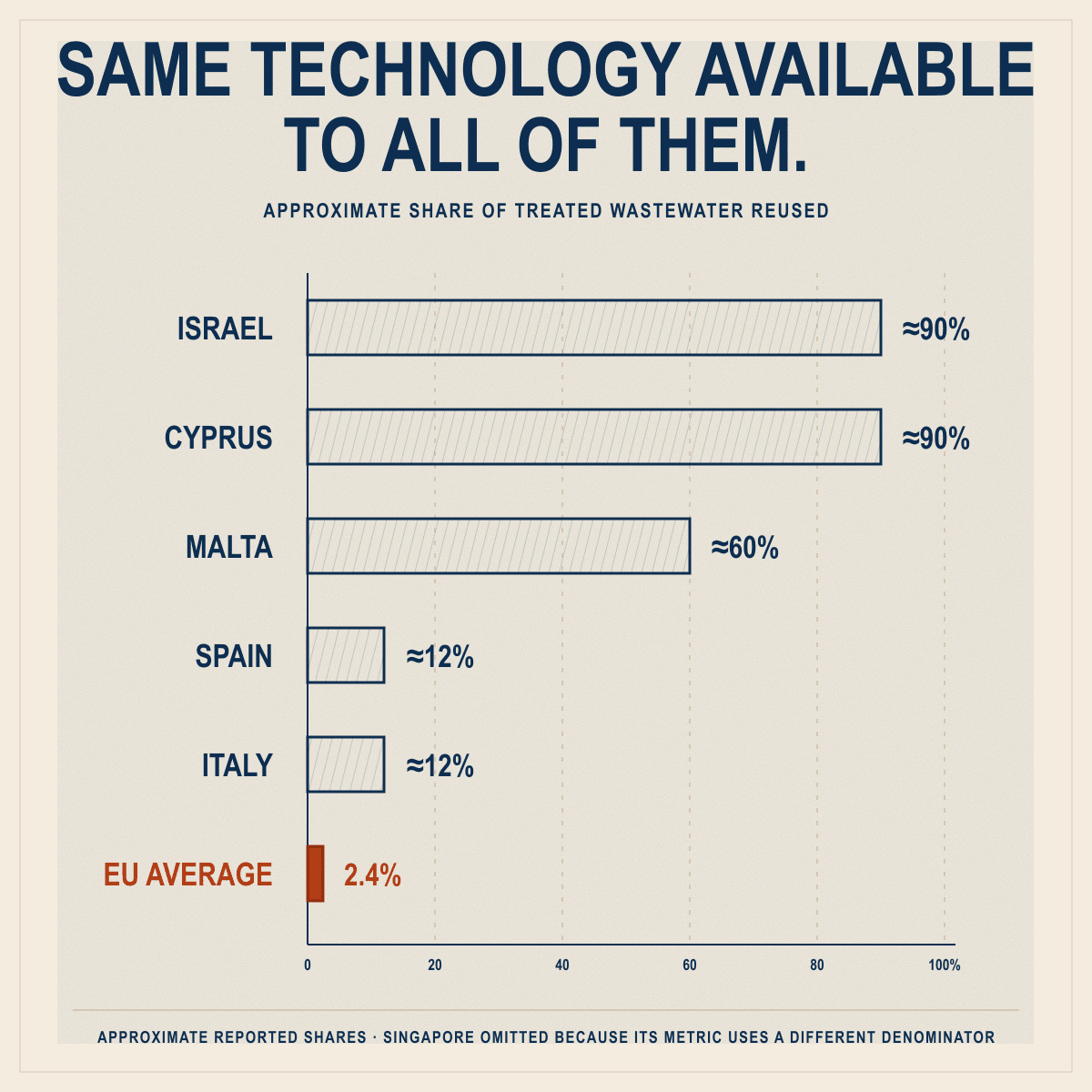
The variation hidden inside that average is enormous. Around 12 percent in Spain and Italy. Roughly 60 percent in Malta. About 90 percent in Cyprus. Spain reused 343 cubic hectometres in 2022, led by Murcia, Valencia and Andalusia. The EU’s own water reuse regulation, in force across member states since June 2023, states plainly in its reasoning that high investment costs and an absence of financial incentives are why uptake has been low. A regulator diagnosing its own market, in writing. Member states using reclaimed water for agricultural irrigation had until June 2026 to publish compliance data.
Outside Europe the picture is different by an order of magnitude. Israel at around 90 percent. Singapore covering roughly 40 percent of national demand from reclaimed water, with a target of 55 percent by 2060. California reported around 749,000 acre-feet of recycled water use in 2022 and is, by its own regulator’s assessment, on track for its 2030 target of 800,000 acre-feet, while the 2040 target of 1.8 million looks considerably harder and depends on 95 planned projects arriving.
Membranes do not work differently in Munich than in Tel Aviv. The difference was never technical.
What differed was price, regulation, deadline and public acceptance. And on that last point Barcelona is instructive in an uncomfortable way. Public support for indirect potable reuse in metropolitan Barcelona reached 68 percent during the drought. Not after a communications campaign. After 41 months without enough rain. Acceptance, at least in that case, followed the crisis rather than the explanation.
What this changes for anyone selling into it
If you sell water technology, your proposal almost certainly describes treatment performance. Removal rates, energy per cubic metre, membrane life, compliance with the applicable standard, a reference list. All of it necessary, none of it sufficient.
Because the thing your customer lost was not treatment capacity. It was a buffer. They lost the ability to be wrong about a dry year and survive it anyway. Perth’s fourteen days is not a treatment problem wearing a storage costume; it is a storage problem, and no membrane will fix it.
This is a value translation failure of a specific and expensive kind. The supplier is describing the product accurately. The buyer is experiencing a different problem. Both are being reasonable, and the meeting still ends in “very interesting, please keep us updated.”
A proposal that prices only the treatment step is quoting roughly one third of the job. The other two thirds, storage and transport, surface later during detailed design or during the financing conversation, which is where projects go quiet without ever formally dying. The supplier who can say, in the first meeting, what happens to storage and to conveyance, who owns each, what each costs and on whose timetable each gets built, is answering a question the buyer has but has not yet learned to articulate.
That is not a technical differentiator. It is a commercial one, and it is available to anyone willing to widen the boundary of what they are prepared to talk about.
Every advanced reuse scheme I could find, Perth, Shafdan, Barcelona, Santa Monica, pays to put the water back into the ground or the river before using it again. The industry calls this an environmental buffer.
It used to be called geography.
Figures are as published by the cited sources at the time of writing. The framing of storage, treatment and transport as three formerly free services, and the commercial conclusions drawn from it, are the author's analysis rather than claims made by any source cited.
Sources and verification note
All figures were retrieved and checked at the publisher’s own page. Where a figure is an estimate, a projection or a self-reported operator number, that is stated.
- Water Corporation (Western Australia), “Climate & Perth.” Rainfall down approximately 20 percent since the 1970s; streamflow into dams down 80 percent; pre-1975 average 420 billion litres per year; 2010–2018 average 72.5 billion litres per year; 2015 record low 15.8 billion litres, lowest since records began in 1911, described by the utility as roughly fourteen hot summer days of supply; Groundwater Replenishment Scheme at Craigie recharging since 2017 with capacity up to 28 billion litres per year. Limitation: primary source, but the utility is an interested party in describing its own supply position. The streamflow series is measured; the attribution to climate change is the utility’s own.
- Perth Groundwater Replenishment Scheme Stage 2. A$262 million expansion, doubling recharge from 14 to 28 gigalitres per year into the Leederville and Yarragadee aquifers. Government investment figure as publicly reported; scheme under assessment by EPA Western Australia.
- Gleeson, Befus, Jasechko, Luijendijk and Cardenas, “The global volume and distribution of modern groundwater,” Nature Geoscience, 2016. Approximately 22.6 million km³ of groundwater in the upper 2 km of continental crust, of which 0.1–5.0 million km³ is less than 50 years old; less than 6 percent is modern. Limitation: a modelled global estimate with a wide stated range on the modern fraction. The 0.1–5.0 million km³ span is the authors’ own uncertainty and should not be collapsed to a point value.
- Israel and the Shafdan scheme. Israel reuses close to 90 percent of its wastewater effluent; Shafdan delivers approximately 140 million m³ per year to Negev agriculture, irrigating more than 60 percent of it; tertiary treatment is soil aquifer treatment. Limitation: the 90 percent national figure is widely reported across sector and government sources with minor variation, with some sources stating 85 percent reclaimed for agricultural use. It should be read as “approximately 90 percent,” not as a precise audited value.
- Barcelona and the El Prat indirect potable reuse scheme. 41-month drought 2021–2024; up to 2 m³/s of advanced-treated reclaimed water discharged to the Llobregat 16.6 km upstream of the drinking water intake; supply mix in April 2021 of rivers 63 percent, wells 34 percent, desalination 3 percent, shifting by 2024 to desalination and reuse combined exceeding 50 percent; public support for indirect potable reuse reaching 68 percent during the drought. Limitation: the public support figure comes from survey research conducted during an acute emergency and should not be read as a stable long-term preference.
- European Union water reuse. Approximately 1 billion m³ of roughly 40 billion m³ of treated wastewater reused annually, about 2.4 percent; approximately 12 percent in Spain and Italy, around 60 percent in Malta, approximately 90 percent in Cyprus; Spain reused 343 hm³ in 2022. Regulation (EU) 2020/741 applicable across member states since 26 June 2023, and citing high investment need and absent financial incentives as reasons for low uptake; member states using reclaimed water for agricultural irrigation required to publish compliance data by 26 June 2026. Primary regulatory text plus European Commission and European Environment Agency reporting.
- California State Water Resources Control Board. Approximately 749,000 acre-feet of recycled water use reported for 2022, of which around 26 percent potable; statewide goals of 800,000 acre-feet by 2030 and 1.8 million by 2040; 95 planned projects identified; direct potable reuse regulations effective October 2024. Colorado adopted the first US direct potable reuse rule in 2022. Limitation: the 2030 and 2040 figures are policy targets, not forecasts.
- Singapore PUB. NEWater supplying approximately 40 percent of national water demand, with a stated target of up to 55 percent by 2060. Note: this measures share of national demand, not share of wastewater reused, and is therefore not directly comparable with the other percentages above. It is omitted from the comparison chart for that reason.
- NASA / International Space Station. Water recovery aboard the ISS at approximately 98 percent. Widely reported NASA figure, used illustratively rather than as a load-bearing claim.
Authorial interpretation, not sourced claim: the framing of storage, treatment and transport as three services formerly provided without cost; the argument that reuse relocates these onto the balance sheet; the reading of the indirect-versus-direct potable reuse distinction as a price question about replacing the buffer; the detection-time argument; and the conclusion that suppliers pricing only treatment are quoting one third of the job. None of the sources above make these claims.