- Program purpose
- Practitioner-academic teaching that bridges two communities that rarely share a curriculum: academic research in innovation diffusion, institutional theory, and technology management — and commercial practice in clean technology, water, and environmental infrastructure. The central framework is applied during the session, not merely described.
- Who it is for
- MBA and Executive MBA, executive education, innovation and technology management, environmental and water resources engineering, sustainability and clean energy management, entrepreneurship, industrial engineering, and international business programs.
- Typical situations
- Programs seeking industry-grounded commercialization content; engineering faculties adding commercial capability to technical curricula; executive education for clean-tech and infrastructure leaders.
- Core questions addressed
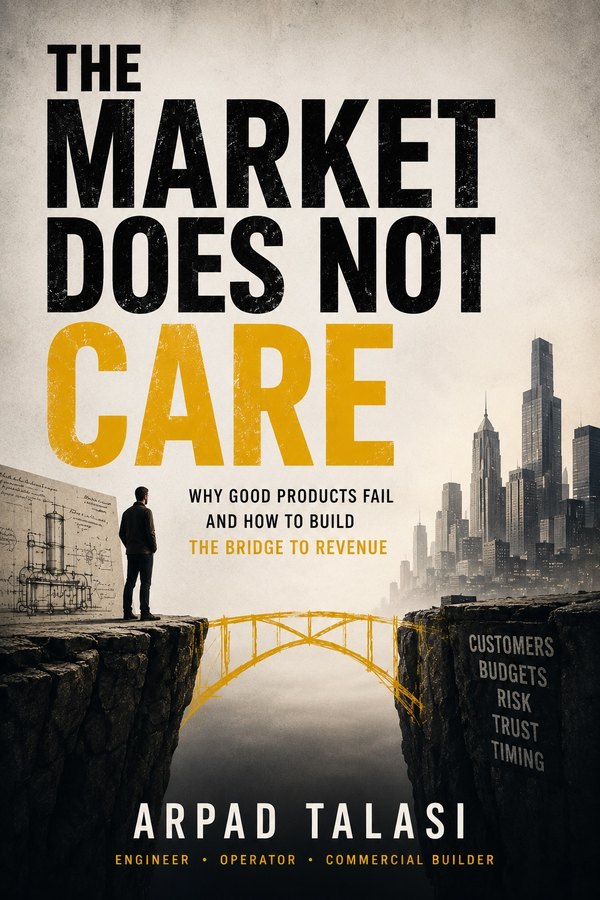
- Why do technically superior clean technologies fail commercially? How do technology readiness and commercial readiness diverge — and why do organizations systematically underinvest in the latter? Why do pilots fail to become procurement? How are institutional markets entered and scaled?
- Format options
- Guest lecture (60–90 minutes): structured presentation with Q&A, adaptable to program context, optionally with a live diagnostic exercise. Applied seminar (half day): framework instruction plus applied case analysis; recommended for 20–30 participants. Executive / masterclass workshop (two days): theory, diagnostics, and case-based instruction with assessment-compatible case-analysis output. The materials can support a full-semester applied course. Delivery in English, German, or Hungarian; materials in English. In-person delivery across Europe, North America, Australia, and Southeast Asia; online globally.
- Typical outputs
- Applied diagnostic exercises; structured case-analysis outputs; teaching materials.
- Example modules
- The Commercialization Gap in clean technology (Rogers, Moore, Christensen, applied through the Five Structural Gaps Model) · from technology readiness to commercial readiness (the TRL–CRI mismatch) · why pilots fail to become procurement (the Pilot Trap and proof architecture) · institutional market entry for complex technologies (channel governance, representative networks, reference strategy) · commercial architecture for clean-tech scale-up (founder-led to institutional sales systems).
- Relevant frameworks
- The full Commercialization Atlas, grounded in peer-reviewed research — innovation diffusion, institutional theory, and transaction cost economics — and delivered through applied diagnostic tools and case analysis.
- Preparation required
- A short program-context brief (audience, level, discipline, learning objectives). A minimum lead time of four weeks is recommended for customized programs.
- Expected participant profile
- Advanced undergraduate, graduate, MBA, and executive participants; faculty and program directors for co-designed formats.
- Follow-up options
- Recurring lectures; adoption of the published books as course or supplementary reading; multi-session executive programs.